
Dots Commander: RTS War
Vira Games Inc.Strategy
3.858.00 Reviews
- Version
- 1.0.6
- Installs
- 50.00K
- Age Rating
- Everyone
Screenshots
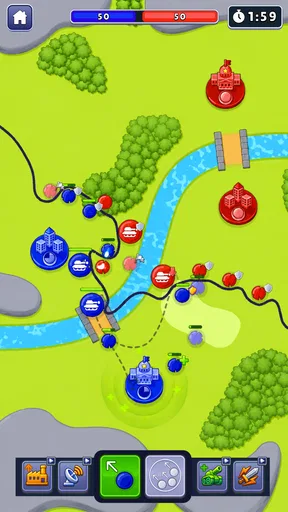
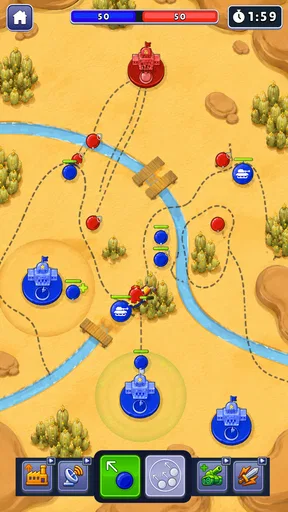
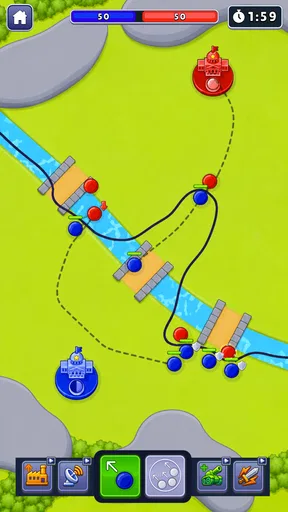
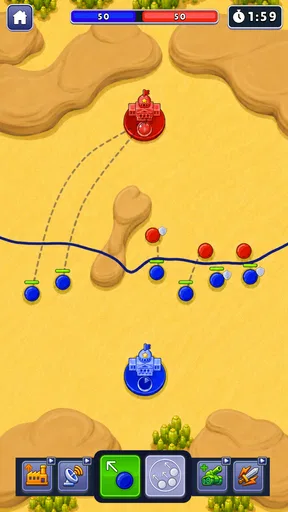
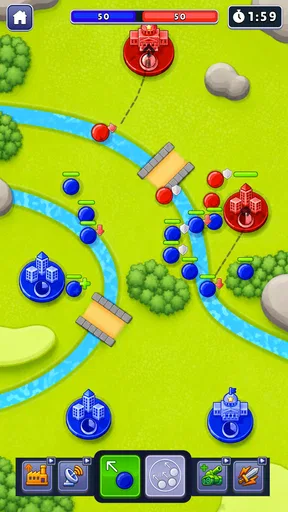
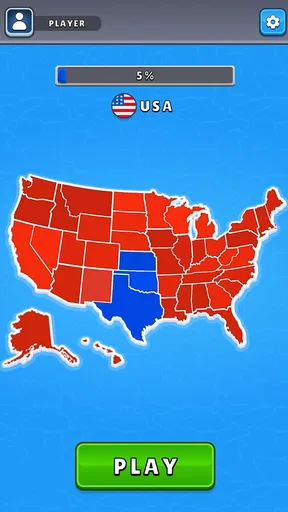
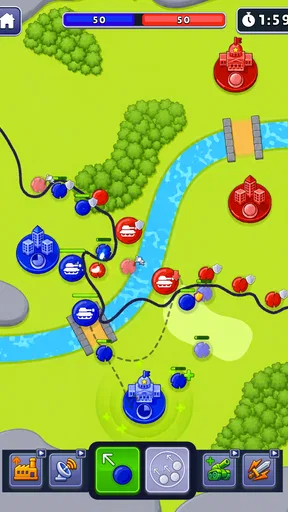
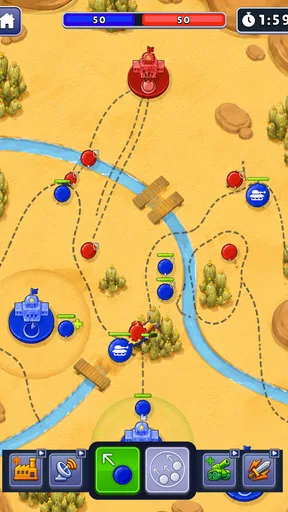
Our Review of Dots Commander: RTS War
 Analysis by Appyee
I went into Dots Commander: RTS War expecting a compact strategy game built around quick decisions, and that is exactly the impression it gives. You command dots, push toward cities, and try to turn a small position into a stronger army. The idea is easy to understand almost immediately, but the appeal comes from deciding when to move, when to expand, and when a tempting attack is actually a mistake.
This is a free strategy game from Vira Games Inc. with an Everyone age rating, so it is approachable for a broad audience. It has passed the early curiosity stage too, with more than fifty thousand installs and a 3.8 average from roughly sixteen hundred ratings. Those figures suggest a game that attracts attention but also leaves room for personal taste; after playing, I can see why. The central loop is simple, while the satisfaction depends heavily on whether you enjoy short tactical contests rather than deep, long-form strategy.
How the first move sets the whole match in motion
The first action is usually the most important because it establishes the shape of the session. You are not spending a long time reading menus before the game becomes understandable. The battlefield presents the basic problem clearly: claim space, reach cities, and grow enough strength to challenge what stands in your way. I like that the opening is direct. It makes the game suitable for a quick break, but it also means your early choice has less room for elaborate preparation than in a traditional real-time strategy title.
My advice is to resist treating the nearest city as an automatic target. A city may look like the obvious reward, yet the route toward it can leave your starting position exposed. I found it more useful to think in terms of connected progress: secure a useful area first, then move toward the next objective when the position feels stable. That small change in mindset makes the game feel more strategic than simply tapping whatever is closest.
The dots are the defining visual language, and they keep the battlefield readable. Instead of managing a crowded interface full of panels, you are focused on movement, territory, and the relationship between your force and the cities around it. That clarity is one of the strongest reasons I would suggest this game to someone who likes strategy but does not want a complicated control scheme.
At the same time, players looking for a fully featured command simulator should adjust their expectations. This is not the kind of experience I would choose when I want detailed unit roles, a large technology tree, diplomacy, or a campaign that demands a long-term economic plan. Its strength is the immediate decision, not the number of systems layered on top of it.
The opening is best played as a positioning puzzle
The useful question during the first minute is not simply “What can I capture?” but “What will this capture let me do next?” A city can be valuable because it advances your army, opens a route, or gives you a safer base for the next push. That makes each action feel connected to the following one. If you only chase visible rewards, you can end up moving aggressively without building a position that supports the next attack.
I also found that the game rewards watching the whole field before committing. A quick glance can reveal whether an expansion creates a strong line or leaves an awkward gap. This is a practical habit for new players: make one deliberate move, observe the response, and only then decide whether to continue pressing forward. It prevents the common mistake of turning the first successful capture into an uncontrolled rush.
That approach gives the opening a nice rhythm. You act, see the battlefield change, and immediately have a new problem to solve. The feedback is visual and easy to follow, which matters on a phone where a complicated display would make every decision feel slower than it really is.
The feedback rhythm keeps small decisions meaningful
The core feedback cycle is straightforward: I move the dots, the map changes, a city or area comes under pressure, and the new position tells me what deserves attention next. That sequence is the heart of the game. It creates a clear connection between an action and its consequence, so even a short session can feel complete rather than like a fragment of a much larger match.
What I appreciate most is that the game does not require me to memorize a large rulebook before I can understand whether a decision worked. Success is visible in the changing balance of the map. When an advance opens a better route, I can feel the improvement immediately. When I overextend, the problem is equally apparent because my next move becomes harder to support.
This rhythm also explains why the game can be appealing to casual players. You can begin with a simple objective and learn through the response. There is no need to master every possibility before enjoying the first few attempts. For a friend who wants a strategy game during a commute or while waiting for an appointment, that accessibility would be a genuine advantage.
However, the same simplicity can become a limitation for experienced strategy players. Once you understand the basic relationship between expansion and pressure, you may want more variation in the way opponents respond or more ways to recover from a poor position. The game’s feedback is clear, but clarity is not the same as depth. I would not recommend it as a replacement for a complex real-time strategy game if your enjoyment comes from managing many interacting systems.
Use the response to plan one move ahead
A useful technique is to treat every successful action as information rather than just a reward. After taking ground, pause long enough to inspect the new shape of your position. Ask whether the advance gives you a better route or merely makes the map look larger. This is where the game becomes more thoughtful than its simple presentation suggests.
Another practical tip is to avoid spending your momentum on a dramatic attack when a smaller improvement would make the next decision easier. In a short strategy game, the urge to create a big turning point can be stronger than the need to build a reliable position. I had better results when I used a modest advance to improve the next choice instead of trying to finish everything in one push.
The feedback loop is especially effective for players who enjoy learning by repetition. A failed attempt is not difficult to understand: you can usually identify the moment when your position became too ambitious or too scattered. That makes restarting less frustrating than in games where defeat feels random or hidden behind complicated calculations.
Why capturing a city feels rewarding without becoming overwhelming
The reward in Dots Commander: RTS War is tied closely to visible progress. Capturing cities and building an army give the session a clear sense of growth. I like this because the game does not need a long explanation to communicate what I am working toward. The map itself becomes the record of my decisions, and every successful expansion makes the next objective feel more achievable.
That reward is strongest when I have earned it through restraint. A city taken after careful positioning feels better than one reached by blindly moving forward. The game encourages that feeling because the value of a capture is not only the immediate change; it is also the way the new position affects the rest of the match.
For younger players and newcomers, this direct reward structure is helpful. The Everyone rating fits the approachable presentation, and the basic objective is easy to explain: command the dots, conquer cities, and grow your force. A parent looking for a strategy game that does not begin with an intimidating wall of systems may find this a comfortable starting point.
For adults who want a more demanding experience, the reward may feel lighter over time. There is a difference between a satisfying tactical win and a deep progression system that keeps revealing new layers. I would describe this game as better for repeated short challenges than for a single, expansive strategic journey.
The free entry point is useful, but spending needs attention
The game is free to download, which makes it easy to try without committing money first. That is important here because the main question is whether the compact command loop matches your taste. You can discover that through play rather than relying on a long description of systems you may never use.
There are in-app purchases ranging from $1.99 to $9.99 per item. I would keep that in mind before handing the game to a child, even though the content rating is Everyone. The presence of purchases does not automatically make the experience unsuitable, but it does mean that a family should use the usual device-level purchase protections and decide in advance whether spending is allowed.
For my own use, the best way to approach the store is as an optional convenience rather than part of the strategy itself. I would first learn the basic loop and decide whether the game is enjoyable without buying anything. That keeps the evaluation honest and prevents a small tactical game from becoming an impulse-purchase experience.
Why the reset matters more than the individual defeat
The reset is what gives the game its replay value. After a match ends, the reason to begin again comes from wanting to make the opening cleaner, protect a previous weakness, or reach a city with a better plan. I enjoy this kind of structure because the game does not need to promise a huge commitment every time I open it. A session can stand on its own, then invite another attempt because I know exactly what I would change.
That reset also makes mistakes useful. If I lose because I expanded too quickly, the next attempt has a clear purpose. I can slow the opening, improve the route, and see whether that adjustment changes the outcome. This action-feedback-reset pattern is more compelling than simply repeating a level without understanding what went wrong.
The trade-off is that players who prefer persistent progress may find the reset less motivating. If your favorite strategy games are built around a long campaign, permanent upgrades, or a carefully developed empire, the short-session structure may feel too temporary. I would choose a different game for that kind of investment. Here, the reward is improvement in decision-making and a better result, not necessarily a sprawling record of everything you have built.
A realistic everyday use case is a ten-minute pause between tasks. I can start a session, make a few deliberate moves, and either finish or stop at a natural point without needing to remember a complicated economic plan. The next time I return, the objective is immediately understandable. That makes it more convenient than a large strategy title when I only have a small amount of attention available.
When a restart is productive and when it is not
I would restart when the position has become structurally poor, not merely because one move failed. A setback can sometimes be recovered from, and learning to distinguish a temporary problem from a doomed position is part of the strategy. Restarting too quickly removes the chance to understand how much pressure the game actually allows you to absorb.
On the other hand, if your early moves have left you with no sensible route toward the cities, repeating the same plan is unlikely to help. The most productive reset changes one important decision rather than everything at once. For example, you might keep the same target but approach it more carefully, or choose a safer expansion before attempting the attack again. That gives each replay a small experiment to test.
This is one of the less obvious strengths of the game: its simplicity makes cause and effect easier to study. There are fewer distractions between your command and the result. The downside is that the game may offer fewer alternative solutions than a larger strategy title, so the learning curve can flatten once you have found a reliable approach.
Who should play it, and who should choose something else
I would recommend Dots Commander: RTS War to players who like map-based strategy, quick tactical choices, and a clear path from action to visible progress. It is a good fit if you want to understand the objective quickly, play in short bursts, and improve by trying a different opening on the next attempt. The dot-based presentation also makes it less visually demanding than many war games, which helps when playing on a smaller phone screen.
It is particularly suitable for someone new to strategy games. The basic idea is not buried under menus, and the game gives you a practical lesson through the consequences of your own decisions. A player can begin by following the obvious objective, then gradually learn to think about routes, spacing, and the value of a stable position.
I would skip it if you expect a detailed military simulation, a long campaign, or a large collection of specialized units. I would also look elsewhere if you dislike restarting after a failed attempt or if you need a strong story to give every battle meaning. Those are not flaws in the same way for every player; they are simply signs that the compact loop may not match what you want from a strategy game.
Compared with a typical large real-time strategy game, this one is easier to enter and faster to understand, but it gives up complexity. Compared with a very casual puzzle game, it asks for more planning because each expansion changes the tactical situation. That middle position is its identity: it is more thoughtful than a purely reflexive time-filler, yet much lighter than a full desktop-style commander experience.
What to expect from the current release
The current version is 1.0.6, and the game supports devices running Android 7.1 or later. That makes it accessible to many older Android phones, which is useful if you are not using a recent flagship device. I would still judge the experience on your own screen size, because a strategy game based on small map elements benefits from controls and visuals that remain comfortable to read.
Knowing the supported system is also helpful when recommending it to someone else. If a friend uses an older Android phone, the stated minimum is reassuring, but the practical question remains whether the interface feels clear on that particular display. The game’s simple visual approach should help, though I would not assume every device offers the same comfort.
Vira Games Inc. has kept the concept focused rather than presenting it as a broad collection of unrelated modes. That focus works in its favor when you want a quick command game, although it also means the experience depends on whether the central loop stays interesting after repeated sessions. My enjoyment came from refining decisions, not from discovering a large number of separate activities.
My verdict on the complete action-to-reset loop
Dots Commander: RTS War works because its cycle is easy to feel: make a move, watch the map respond, gain ground, discover the next pressure point, and decide whether another attempt can be better. The reward is not just conquering a city; it is understanding why the route worked and carrying that lesson into the next session.
I like the game most when I treat it as a compact tactical exercise rather than a full war simulation. Its strongest qualities are accessibility, readable progress, and a reset structure that makes improvement tangible. Its main weakness is the same simplicity that makes it welcoming: players seeking deep systems, long-term empire building, or endless strategic variety may run out of reasons to continue sooner than they would in a larger alternative.
With a 3.8 average and a free entry point, it is an easy game to try, but I would not recommend it blindly to every strategy fan. Try it if you want short contests where one decision can reshape the next few moves. Skip it if your ideal session involves managing a complex economy or developing a campaign over many hours. For the right player, the loop is clean, understandable, and pleasantly repeatable, making each new match feel like a chance to command the dots with a little more confidence.
My final recommendation: give it a chance when you want a lightweight strategy game with immediate action and a meaningful reason to restart. It will not replace a deep real-time strategy classic, but it does offer a focused way to practice positioning, timing, and controlled expansion without turning a short phone session into a major commitment.
Verdict
Strengths of Dots Commander: RTS War
- Quick matches make it easy to play during short breaks.
- Simple controls are accessible for newcomers to RTS games.
- Unit variety encourages different tactical approaches.
- Strategic positioning matters more than rapid tapping.
- Works well for players who enjoy competitive battlefield decisions.
Limitations of Dots Commander: RTS War
- Some matches may feel repetitive after extended play.
- Progression can become demanding without regular play.
- Small battlefield details may be difficult to read on phones.
- Online competition may be frustrating for inexperienced players.
- Battery use can increase during longer battles.
Other Releases by Vira Games Inc.
View All
Life Sim 3D: Family Simulator
Simulation4.5

DUST: Dirt ATV Offroad Racing
Racing3.5
Similar Picks in This Category
View All
Clash of Clans
Supercell4.5

Plants vs. Zombies™
ELECTRONIC ARTS3.7

Lords Mobile: Kingdom Wars
IGG.COM4.5

Clash Royale
Supercell4.4

State.io — Conquer the World
CASUAL AZUR GAMES4.1

Car Driving School : Car Games
Spark Game Studios3.9
Frequently Asked Questions
What is Dots Commander: RTS War?
Dots Commander: RTS War is a real-time strategy game focused on commanding units, capturing territory, and defeating opposing forces through tactical decisions. Players typically need to manage their army, choose where to attack, defend important positions, and adapt to changing battlefield conditions. Its simple visual style makes the action easy to follow, while the strategic layer gives each match more depth than a basic arcade game.
How does the gameplay work in Dots Commander: RTS War?
The main gameplay revolves around controlling troops and directing them across the battlefield in real time. You must decide when to advance, which targets to prioritize, and how to distribute your forces instead of sending every unit into the same fight. Matches reward quick reactions, but planning is equally important because a poorly timed attack can leave your base exposed and allow the opponent to regain control.
Is Dots Commander: RTS War suitable for beginners?
Yes, the game is generally approachable for newcomers because its core objective is easy to understand: command your units, overcome enemy defenses, and control key areas. However, becoming consistently successful requires practice. Beginners should first learn how unit movement, attacks, reinforcements, and defensive positions work before attempting more aggressive strategies. The early matches are useful for understanding the interface and developing better battlefield awareness.
Does Dots Commander: RTS War require an internet connection?
Connection requirements can depend on the version and features available on your device. If the game includes online battles, matchmaking, leaderboards, advertisements, or cloud-based progress, an internet connection may be necessary for those functions. Some parts may work offline, but users should not assume that every mode is available without connectivity. Checking the store description and permissions before downloading is recommended.
Is Dots Commander: RTS War free to download and play?
Dots Commander: RTS War may be available as a free download, but the exact monetization model can vary by platform, region, and version. Free games commonly include advertising, optional purchases, or systems that let players unlock content more quickly. Before installing, review the app-store listing for in-app purchase information and age guidance. This is especially important if the game will be used on a shared family device.
Play our best games!


